Red Weaver Rediscovered in Kenya
30 July 2026

Joshua Bergmark
Another successful lost bird search, this time Red Weaver found in Kenya by our good friend James Apolloh Omenya. Below is his recount of searching the remotest corner of his country, fully engaging the local community to help out.
Ornis Birding x Lost Birds Grant Program
Blog: Chasing Ghosts - In Search of Kenya's Lost Birds
Written by James Apolloh Omenya
There are birds you go looking for, and there are birds that go looking for you. For eleven days between 30th June 2026 and 10th July 2026, a six-person team of Kenyan birders set out into the Boni-Dodori Forest of Lamu County and the floodplain of the lower Tana River to search for two of them: the Red Weaver, a scarlet-headed ghost of a bird known locally as "Shongwe Kudhuthe," and the Tana River Cisticola, a small streaky bird that hasn't been reliably seen since before most of us were born. One of these birds found us. The other is still out there. This is the story of the search for two of Kenya's most elusive species, and of the chiefs, county commissioners, motorcycle riders, village elders, and armed escorts who made it possible.
The Team
Six of us carried this expedition across eleven days, though never all together in one place. I led the survey as expedition leader, alongside Dr Victor Ikawa, Simon Odhiambo ("The Kenyan Birder," one of Kenya's finest bird photographers), James Mburu, Paul Kaberere, and John Gitiri, who joined us midway through. We were supported throughout by an equally essential second team: Mohammed Noor and Charles Wanjala, our motorcycle riders and local guides from Aweer Conservancy; Hassan Golo of the Nature Kenya Tana River Site Support Group; and our driver Caleb, who never left our side.
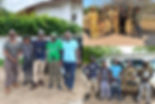
Clockwise from left: Team 1, Team 2, and last day of the expedition.
A Plan Rewritten on Day One
We left Watamu at dawn on 30 June, five of us in one vehicle, and by evening had reached Hindi, gateway to the Boni-Dodori Forest. That evening we met Mohammed Noor for the first time ("Manager," as everyone calls him) who introduced us to Chief Jamal. Our plan was to move into the forest as a team of five. Chief Jamal had other ideas. Moving five outsiders through the villages of Kiangwe, Basuba, Mangai and Mararani, he told us, would draw far too much attention for the available security to manage safely. He advised cutting the Red Weaver team down to two people.
It was not the news we wanted on our first evening. But we took it, because it was the only way forward. Simon Odhiambo and I would go on alone for the Red Weaver. Victor, James Mburu and Paul would begin the Tana River Cisticola search the next morning, starting from Hindi toward the historical localities at Ijara and Sangole. What had been one expedition became two, running in parallel, reuniting only by phone calls made from a single tamarind tree with mobile signal a kilometre outside Mangai.

Evening with Chief Jamal at Hindi (left), and Assistant County Commissioner and Chief Jamal after giving us the final pass (right).
Into the Forest
Getting into the Boni-Dodori Forest turned out to be its own expedition. We needed sign-off from the Assistant County Commissioner, then the Lamu County Commissioner himself, Mr Sangolo, who heard out our plan and cleared us, on condition we return to Chief Jamal for a final signature. At the first Kenya Defence Forces checkpoint before the boat crossing at Ndununi, our paperwork still wasn't enough; we were turned back for lack of an official stamp. Simon, in his role as a Nature Kenya board member, got Nature Kenya on the phone, and within hours a stamped introduction letter had been drafted, forwarded, and printed. We tried the checkpoint again. This time we were waved through.
Two motorbikes, loaded with two riders, two birders and all our gear, carried us forty-five minutes through forest track to the boat launch at Ndununi. The bikes went onto the boat with us. We crossed into what the Boni people simply call "Boni Forest," and Kiangwe, not Milimani, cancelled for security reasons. became our first stop.

The untouched habitat of Boni Forest.
Three Red Birds
The days that followed were a rhythm of checkpoints and chiefs: report to the Kenya Defence Forces post, present yourself to the village head, ask permission, then go birding. At Basuba, roughly ten community members joined our search on the spot and to our surprise, they already knew the bird we were after. They had seen it before. They gave us leads on two nearby villages. By the time we reached Mangai, we were moving with a four-person Kenya Defence Forces escort: two ahead, one to the side, one behind. It made for an unusual kind of birding.
Then, on the morning of Day 4, walking from Mangai toward Mararani with Mohammed, our escort, and the constant, distracting calls of Zanzibar Greenbuls and a flame-winged Fischer's Turaco overhead, three red birds burst from a bush without warning. "Our birds!" Simon and I shouted, in unison, and ran.
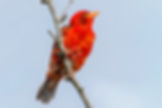
Male Red Weaver by Simon Odhiambo (@Kenyanbirder)
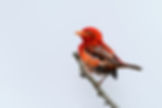
Male Red Weaver by Simon Odhiambo (@Kenyanbirder)
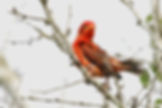
Male Red Weaver by James Apolloh
For almost two hours, three adult male Red Weavers played hide-and-seek with us through the bush, glowing scarlet in full display, while two females kept a careful distance. We photographed, filmed and recorded them. And then we noticed a third bird which wasn't quite a female at all, a young male, confirmed only later on review of the photographs. To our knowledge, this is the first modern evidence that Red Weavers are actively breeding in the Boni-Dodori Forest.
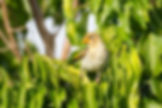
Juvenile Male Red Weaver - The First Breeding Record in Mangai
That evening, the whole community of Mangai celebrated with us. Five chickens were cooked in our honour. It was there, over that shared meal, that we learned the bird's local name: Shongwe Kudhuthe "the weaver that is red in colour" a name that traces back to Basuba, the ancestral home of all four villages we'd passed through.

Clockwise from top left: Celebrating the Red Weaver, meal time with the birding team, accessing remote habitat, and the people of Basuba Village.
The One That Got Away (For Now)
While we chased red birds through the forest, the other half of our team was chasing something far quieter. The Tana River Cisticola was described from a handful of specimens collected near Karawa in 1967, and in the decades since almost nobody has confidently claimed one. The call has never even been properly described.
Victor, James Mburu and Paul spent their days working through Ijara, Sangole, Jalish and the Lower Tana near Garsen, often under armed Kenya Wildlife Service escort, wading into landscapes increasingly swallowed by an invasive shrub called Prosopis juliflora (locally known as Mathenge) that chokes out the open grassland the cisticola likely needs. In one particularly striking find, we discovered that a commercial bank now stands on the exact spot where the species' original type specimen was collected.
When our two teams reunited at Hindi and later regrouped for the Tana River phase, we widened the search further: Kulesa's rice fields, the reedbeds of Ozi reached by boat through the Tana Delta, the school grounds and old flooded fields around Idsowe. We met a Kenya Wildlife Service warden who went birding for the very first time in her career. We met farmers who welcomed us straight onto their land. We saw Coastal Cisticolas everywhere but never quite the bird we'd come for.
Twice, though, we came close enough to wonder. At Kulesa, a young cisticola with unusually heavy streaking on its head caught our attention; reviewed against field guides and discussed with a cisticola specialist, it was provisionally called a young Coastal Cisticola, though nobody is 100% convinced on this conclusion. Later on, near a property owned by Mathias Mutuku just outside Kurawa, Simon photographed an adult with the same heavy streaking. The jury is still out on the identification of these birds which were not vocalising.
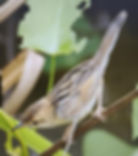
The streaked adult cisticola from Kurawa, tentatively identified as an unusual Coastal Cisticola. But further work needed!
A Consolation Prize with Its Own Surprise
What we did find at Mutuku's property was a bird nobody expected. Late one afternoon, a call carried on the wind from 400 metres away led us to a Tiny Cisticola, a species we didn't expect to find this far from its nearest known population (the lower Galana area). Over two days we counted six individuals in the area, in unexpectedly dry habitat with only a small water reservoir nearby. This appears to be a notable range extension for the species.
It also raised a question that will stay with us long after this expedition ends: if a small, easily overlooked cisticola can be living undetected in dry habitat like this, could the Tana River Cisticola be doing exactly the same thing, somewhere we haven't yet thought to look? We extended the expedition by an extra day to keep searching, but didn't find our answer. Yet we left with a much better question than the one we arrived with.
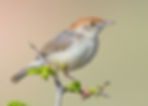
Tiny Cisticola in Kurawa
Habitat in Kurawa
What We're Left With
Eleven days, six team members, three vehicles, two motorbikes, one boat crossing, more checkpoints than we could count, and one rediscovery that really matters. The Red Weaver is alive, breeding, and known to at least one community by name in the Boni-Dodori Forest. The Tana River Cisticola remains, for now, a bird defined mostly by its absence but an absence we understand a little better than we did before, and one we're not ready to accept as permanent.
We are recommending plans for the next trip if funds become available. Returning to Mangai and Mararani for better photographs of the female weavers and further evidence of breeding; to Milimani, which security kept just out of reach this time; and back to Kurawa with mist-nets and proper recording equipment, to finally get a definitive answer on those streaked cisticolas (ideally in September, the month the original specimens were collected, when the seed-eating birds of the Tana floodplain are at their most active).
Beyond the birds themselves, this expedition left something else behind: a Nature Kenya introduction letter that opened doors we didn't expect, a network of chiefs and village elders who now know what a bird survey looks like, and communities who told us, again and again, that no one had ever come to look for birds in their area before. In several villages, we were the first scientific bird survey anyone could remember.
We are deeply grateful to the grant from Ornis Birding Expeditions, and of course the Search for Lost Birds at American Bird Conservancy, for making this expedition possible. And to every guide, driver, security officer, chief, elder, and family who fed us, housed us, walked with us, and trusted us with their knowledge of the land. We'll be back.
The full scientific findings from this expedition are being written up for submission to the Journal of Lost Species, and complete field data has been submitted to eBird and the Kenya Bird Map.